This post is part of an ongoing Q&A series. Thirty questions in total exploring themes of initiation, identity, meaning, and transformation.
Each one stands alone, but together they map a deeper conversation I’ve been guiding for years through Tattoo Pathway.
Rather than polished essays or formal teachings, these responses reflect the way things actually unfold in dialogue.
The first question started with a dream. You can go back to it here if you want to see where this began.
Question 14 (AI):
So far you’ve spoken about maps, anchors, rites of passage and record keeping. These are all useful symbols and concepts. But what about when someone feels completely lost? What do you say to someone who doesn’t even know where to begin?
Answer (MN):
Well, those symbols and concepts have utility. They’re tools for navigation, for stability, for orienting. Orientation is knowing which way you’re facing. Navigation is tracking where you are, where you’ve been, and intentionally moving forward. . . and in order to do all that you need to find some stability. It’s the whole process. It’s how you travel with awareness.
But if someone’s completely lost. . . if they’re in that hopeless place. . .then the very first step is accepting that. Just recognising thats where you are. That’s the beginning.
Think about it. If you’ve ever been on a walk and gotten lost, or if you were lost as a child at a shopping centre. . . or even saw a child lost in a crowd, you’ll know what I mean. You’re often lost for a while before you realise it. That moment of realisation is the beginning of returning. You can’t find your way back if you don’t first acknowledge that you’ve gone off track.
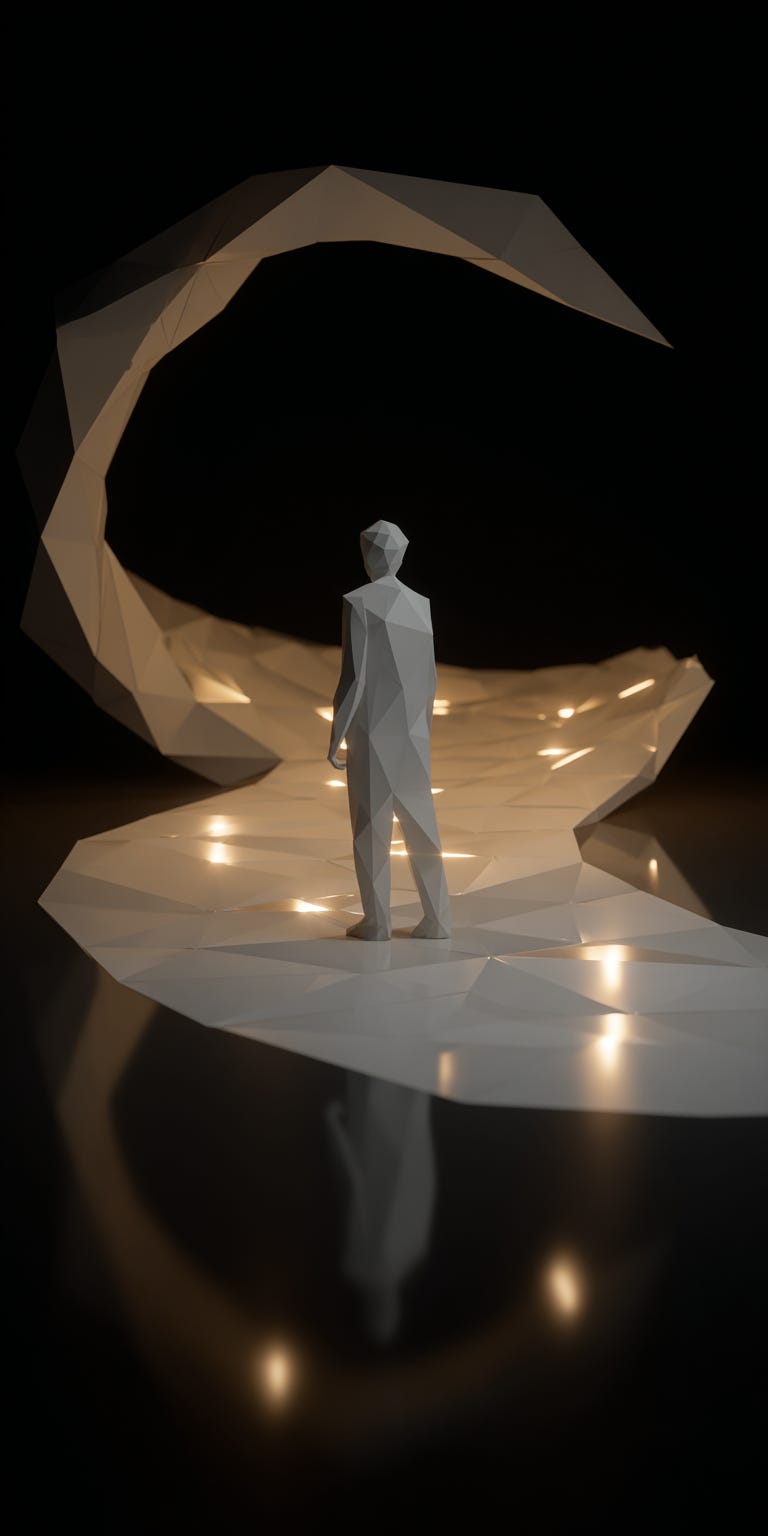
So what I’d say to someone who feels completely lost is this: the moment you notice you’re lost, you’ve already taken the first step back toward your centre. You’re no longer moving blindly. You’re aware. And from that awareness, everything can begin.
You can’t move forward with direction and intention, you can’t form a connection to anything beyond yourself, you can’t come home. . . until you admit that you’ve wandered.
And as soon as you do that, you’re in a perfect position for change. For growth. For movement. It’s actually much harder to be lost and not know it. That’s the dangerous one. That’s when people drift for years, picking things up and putting them down, chasing novelty but never retaining anything, never integrating, never really travelling. Just spinning in place.
So if you’re aware of your lostness, pause. Be still. Pay attention. What can you see from where you are?
I’ve talked about the tools I use with my clients. . . mapping and the Pathfinder. But for someone who’s totally lost, the best place to start is often by looking back. Can you remember a time when you weren’t lost? Can you see any markers. . . any signs of how you got here?
And if you’re in total amnesia. . . which, to be honest, many of us are. . . that’s okay too. Because this isn’t just personal. We’ve been lost collectively for generations. There’s ancestral lostness here. There’s cultural amnesia. And it takes humility to admit that.
So maybe your next step is to look around. Is there someone nearby who can offer guidance? Someone credible? Someone trustworthy? A guide, an elder, a craftsperson, a friend. Someone with lived experience. Someone who’s made it through the territory you’re in.
Depending on the source of your lostness, the guide may look different. But there are people who can help. And you won’t see them if you’re racing forward or pretending you know the way.
So stop. Take stock. Look inward. Look back. And look around. That’s how the path begins. . . by looking at the ground right under your feet.