This post is part of an ongoing Q&A series. Thirty questions in total exploring themes of initiation, identity, meaning, and transformation.
Each one stands alone, but together they map a deeper conversation I’ve been guiding for years through Tattoo Pathway.
Rather than polished essays or formal teachings, these responses reflect the way things actually unfold in dialogue.
The first question started with a dream. You can go back to it here if you want to see where this began.
Question 15(AI):
Tattooing, in its essence, is a permanent act. But we live in a world of impermanence, fast trends, short attention spans, and throwaway meaning. What does permanence mean to you in a culture that resists it?
Answer (MN):
I don’t think we’re a culture that resists permanence, necessarily. The speed of change we’re experiencing isn’t a product of resistance. . . it’s a product of acceleration. Our attention spans have been shortened. . . but that’s more due to the rapid advancement of technology, which has become interwoven into nearly every aspect of our lives.
Look at the digitisation of everything. Economy, communication, identification, education. None of this has happened by conscious cultural choice. It’s just where we’re at in a much bigger cycle. We’re not throwing meaning away, we’re trying to clinging to it. But it’s being washed out of our hands by the pace of change.
Joseph Campbell said it well: the myths of the past no longer suffice. And the pace of life is so fast now that we haven’t had the time (or space) to develop new ones. New narratives can’t anchor us if the river bed keeps shifting beneath them.
Which brings us back to anchors. You can’t anchor if you’re moving too fast. If the vessel’s moving with too much force, the anchor won’t grip. That’s the state we’re in culturally.
Now, when it comes to tattooing, permanence becomes paradoxical. In contemporary culture, people cling to the form, to the fixed image of the tattoo. They want it to remain unchanged. But what usually becomes fluid is the meaning. Or more precisely, their relationship to the meaning.
I see this all the time in my process with clients. We go back through their tattoos. . . fixed, site-specific markings. . . and excavate them. We unearth how much has shifted since they were first made. And sometimes, we find that decomposition has occurred at the root. Meaning has faded, distorted, or taken on new shapes.
If we look back to older cultures, times when life wasn’t moving so quickly. . . the meaning was fixed before the form. The reason for the tattoo was anchored. That meaning shaped the form. That’s a natural order.
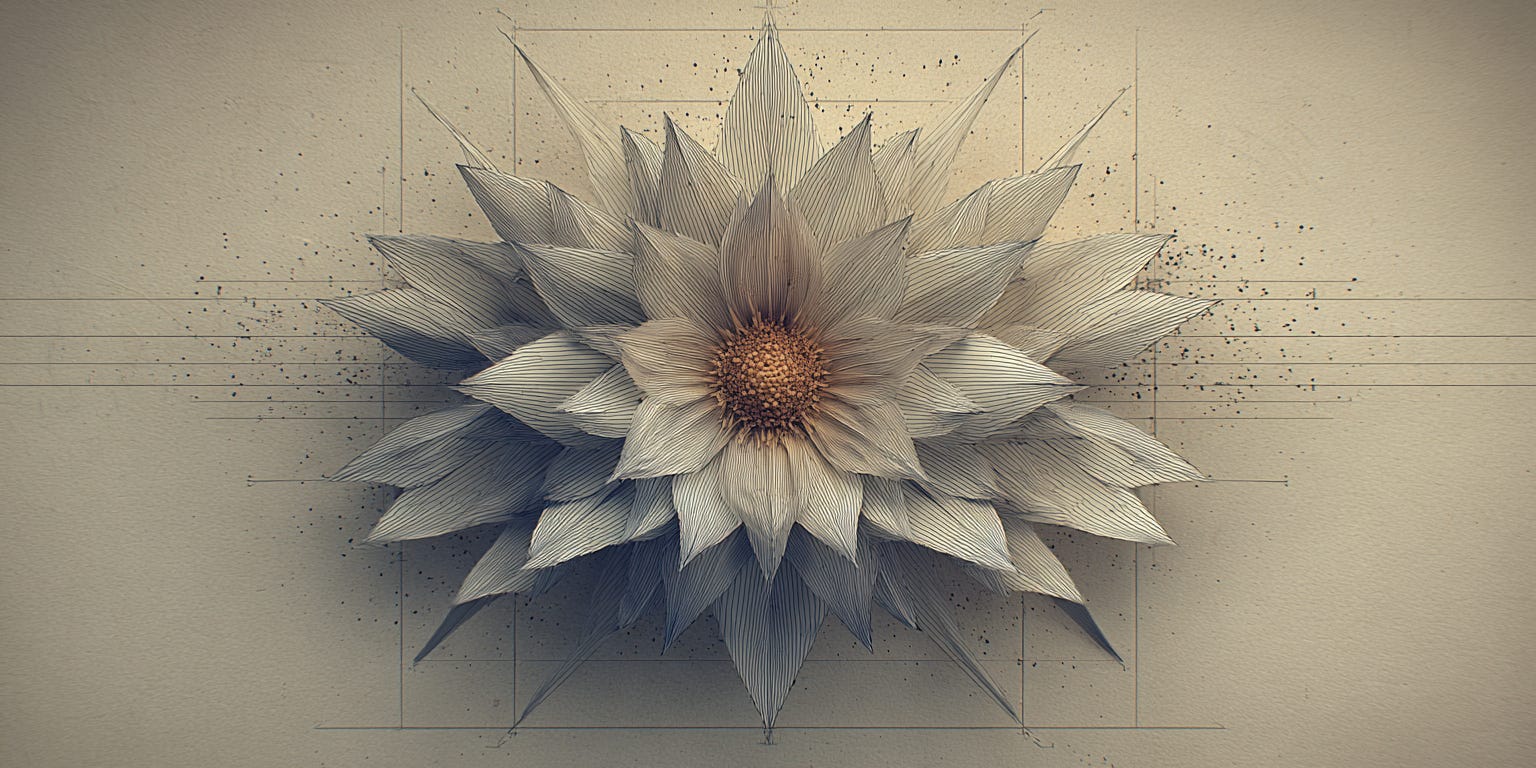
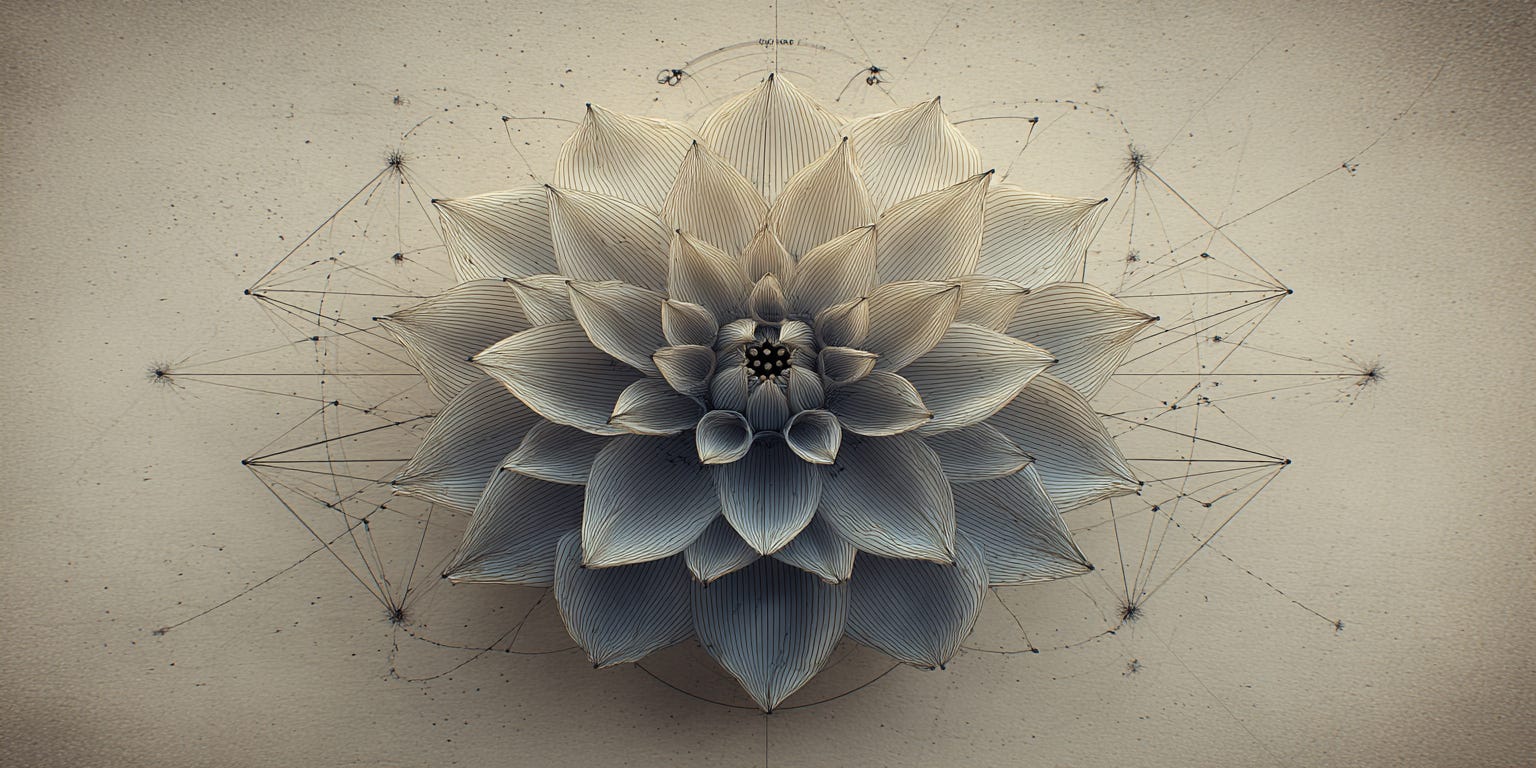
If you look at basic sacred geometry and esoteric architecture¹, it follows this same process. There is a movement through the phases of growth: the seed (point), the stem (line), the leaf (surface), the flower (volume). A flower doesn’t bloom, then drop a stem, then grow roots. And yet, that’s the modern approach to tattooing. We start with the flower. We choose the image, then try to reverse-engineer the meaning. It’s backwards.
Now, that doesn’t mean it’s impossible to get something out of that process. You can harvest the flower because you like the look of it. But it’s a modern, experimental way. And many people find themselves doing that now. . . it’s where we’re at.
But over time, what we’ll rediscover is this: if you start with a good seed in fertile soil, you’ll get a stem, then a leaf, then a flower. The process is encoded. It’s efficient. It’s transferable. It works.
These are archetypal maps for creation, for identity, for purpose. So what does permanence mean in a world moving too fast to hold it? I think it means we have to start with better seeds. We need to fix meaning with care and attention, and then tend to it. We need to trust the encoded processes.
If the ground is fertile. . . if the meaning is real. . . it will form something. Something coherent. Something valuable. Something worth passing on.
In this context, permanence is less about the form lasting forever and more about the effect of that form. Its flower might not last forever, but it might feed something beyond you. It might extend its influence. It might support others. It might stabilise something in your family, your community, your lineage.
So stop fixating on the final form. Stop trying to lock in the outer image. Start with the reason. Start with the meaning. Live intentionally. Move with direction. If you fix your direction. . . not your position. . . you’ll create something real.
And what’s real might not be permanent in the surface sense. . .but it will bloom. It will anchor. It will matter.
esoteric architecture¹ Western esoteric and philosophical traditions, including Pythagorean sacred geometry, Hermetic philosophy, and later Rosicrucian and anthroposophical teachings, describe manifestation as proceeding through ordered stages of geometric and organic unfolding. The point corresponds to the seed, representing undifferentiated potential and origin. The line emerges as the stem, establishing direction, polarity, and axis. The surface unfolds as the leaf, creating plane, interface, and relational exchange with the surrounding field. The volume culminates as the flower, completing embodiment in space and expressing the fullness of form. This progression from point to line to surface to volume reflects the universal principle that all manifested structures arise from latent potential, extend into orientation, expand into relationship, and ultimately arrive in embodied presence, carrying within them the generative capacity to begin the cycle anew.