Principle Six: Tatu Time | The Rhythm Between Tattoos
Tattoo Pathway
May 13, 2026
Tattoo time is one of the most fascinating layers in this whole philosophy, and it’s one of the most obvious gaps in perception between someone who is just getting tattooed and someone who is walking the tattoo pathway.
What we’re talking about when we speak about tattoo time is the relationship between two different dimensions of time, and how they weave through the experience of being tattooed across a lifetime.
Two kinds of time
The ancients had language for this distinction that we’ve largely lost.
Kronos is chronological time. The steady, linear unfolding of days, weeks, years. Timekeeping, neurology, the cycles of seasons, the repetition of rituals, the accumulation of sand in the hourglass. It’s the pattern of motion, the daily returning, the heartbeat to heartbeat rhythm of ordinary life.
Kairos is sacred time. Not measured by clocks but by meaning, by significance, by the sense of walking on different ground. These are moments that pierce the veil. Thresholds. Initiations. Elevated points of transformation.
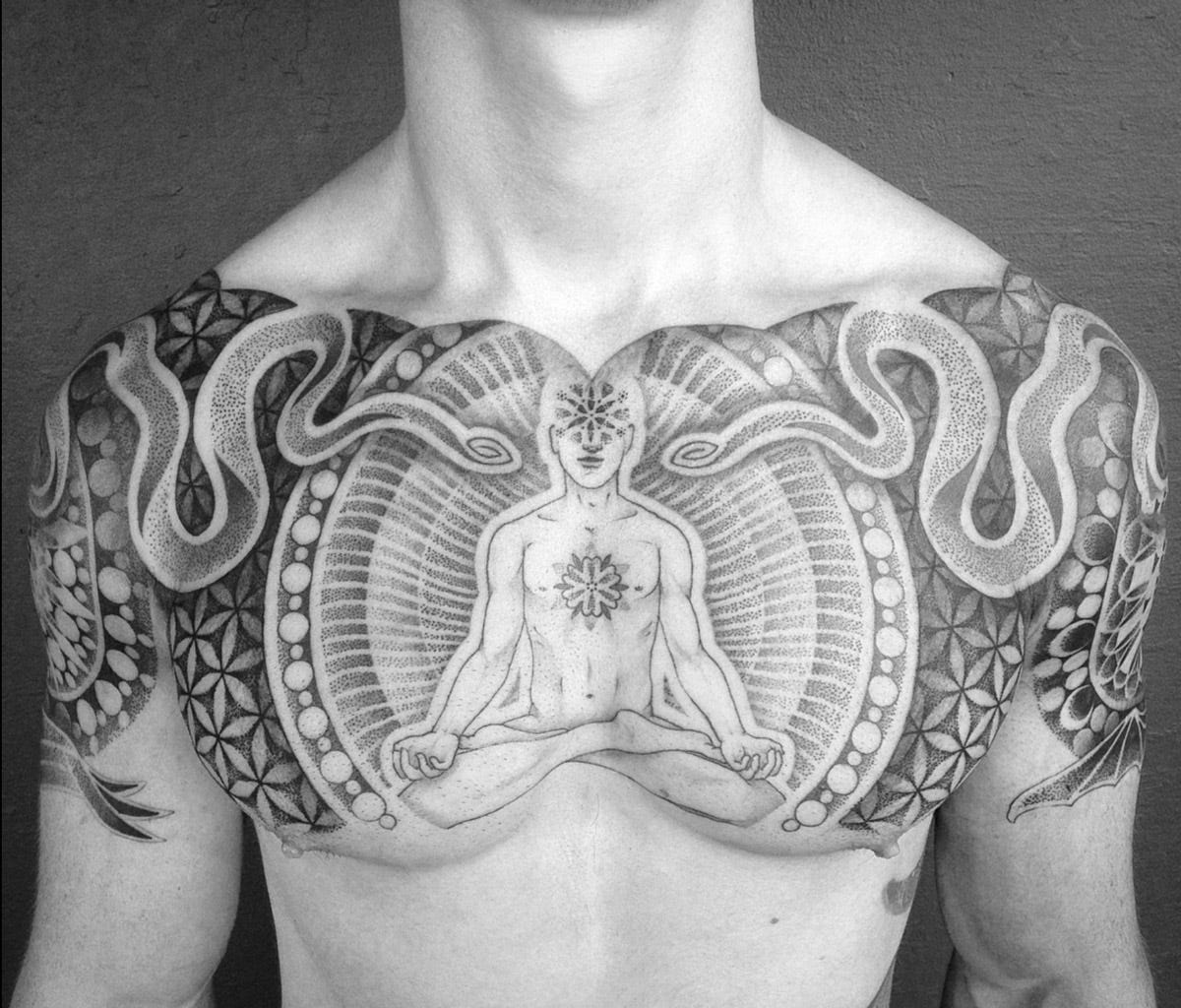
If you imagine time as a sine wave or a spiral coiling outward, Kronos is the steady pattern of that motion. Tattoo time is what happens when certain moments rise above the wave, lifted out of the ordinary flow and marked as significant. When a tattoo becomes a peak moment, an elevated landmark, a vantage point, something is recorded in the body as sacred.
Each of those moments becomes a node in a larger story. Connect them across a lifetime and you see a thread running through your life. A line that binds the elevated moments where you chose to stop, to be intentional, to look back on the ground you’d covered, and then to mark a transformation. A point where the person who journeyed up to that place ceases to exist in quite the same way, and is physically changed, and that change is acknowledged.
This is why what happens between your tattoos matters just as much as the tattoo itself. We move away from asking only what am I getting tattooed and toward asking what life am I living in between that deserves this mark?
Tattooing is not just about the moment under the needle. It’s about everything that surrounds it, before and after. It’s process oriented, not result driven. Relational, not commercial. Transformational, not transactional. The just tattoo club sees tattoos as isolated events: book, get tattooed, heal, move on, collect, consume. Tattoo Pathway sees it differently. The process begins long before you arrive at the studio and continues long after you leave.
Three seasons
Within tattoo time we look at three seasons, each part of a larger spiral.
The approach. The first season begins with the initial stirring. The seed of an idea, the inspirational impulse that arrives and starts to grow. This is springtime. A season of becoming. It’s subtle, and it often asks for patience. The key is not to push it. Not to strive. This season reminds you that there’s a larger force shaping things, that the idea doesn’t come from nowhere. There are tides and orbits and gravitational pulls that make certain moments ripe. If you can catch and move with those forces, you’ll be more supported when you reach the next season.
The action. This is the real kairos moment. The high point. The sacred crossing where the transformation you’ve been moving toward is anchored in the skin. Your trajectory shifts, sometimes subtly, sometimes significantly. The reverberation of your story changes pitch. This is the mark coming forward.
The return. When that moment is done, you begin to descend. To settle. To grow into the new skin and feel how it fits. You make your way back into the valley, and there’s a different pace to the movement now. A resting place. Sometimes you stay here for a long time, and that’s fine. Not every season needs to be answered with action. Ideas and inspiration can come and go without requiring it.
Are you rushing or hesitating?
This principle asks you to recognise what season you’re in. Are you in the approach, feeling the initial stirrings? Are you at the threshold, ready to act? Or are you in the return, integrating, healing, digesting an experience?
It also asks whether you’re rushing or hesitating. Are you moving out of genuine alignment, or out of habit, influence, or desire? Are you missing the boat entirely by waiting too long?
Underneath all of that, what tattoo time is really speaking to is the sustainability of the tattoo process. If you’re constantly cycling through seasons of getting tattooed without integration, you can end up a long way from centre. If you’re stuck at the edge, perpetually biding your time, never acting, you stagnate.
But if you can pay attention and move in harmony with your seasons, paralleling the rhythm of your actual life, tattooing becomes deeply nourishing. It supports where you’re going rather than draining or holding you back.
Tattoo time reminds us to pay attention not just to the physical mark, but to the space between the marks. To acknowledge the approach, honour the peak, and understand the return. To recognise that time isn’t just passing. It’s actively inviting you into a process.
And when you start to move with that, tattooing becomes more than personal. It moves into the communal. It brings you into contact with the timeless, with the cycles and seasons of tattooing for humankind, working with stories being etched into skin in ways that are much older than any studio anywhere in this world now.
Reflection for Principle Six: What season are you in? Are you in the approach, feeling something stirring? Are you at the threshold, ready to act? Or are you in the return, still integrating what’s already happened? Are you walking in rhythm with the seasons of your own life?
Previous in the series:
Next in the series:
Mark Nara is a tattoo artist, educator, and founder of Tattoo Pathway, an initiative reframing tattooing as a conscious, transformational practice.