Principle Four: Mapping | Where You’ve Been, What You’ve Built
Tattoo Pathway
April 24, 2026
Mapping is the principle I’ve spoken about more than any other over the past five or six years. That’s because it’s the main method, the central underpinning of the difference between how most people relate to their tattooing and the approach we take at Tattoo Pathway.
The whole point of a map is that you can read where you are, orient yourself, see where you’ve been, and plot your course forward. At its core, mapping is a navigational tool. And within the Tattoo Pathway framework, there are three distinct layers of it.
The tattoo map
The first layer is the most straightforward. A chronological record of your tattoos, an itinerary through time. You take each marking and look at everything it holds: not just the visual, but the contextual, the emotional, the energetic. Together they give you a clear picture of the whole terrain you’ve traversed from your first tattoo to your most recent one.
The body map
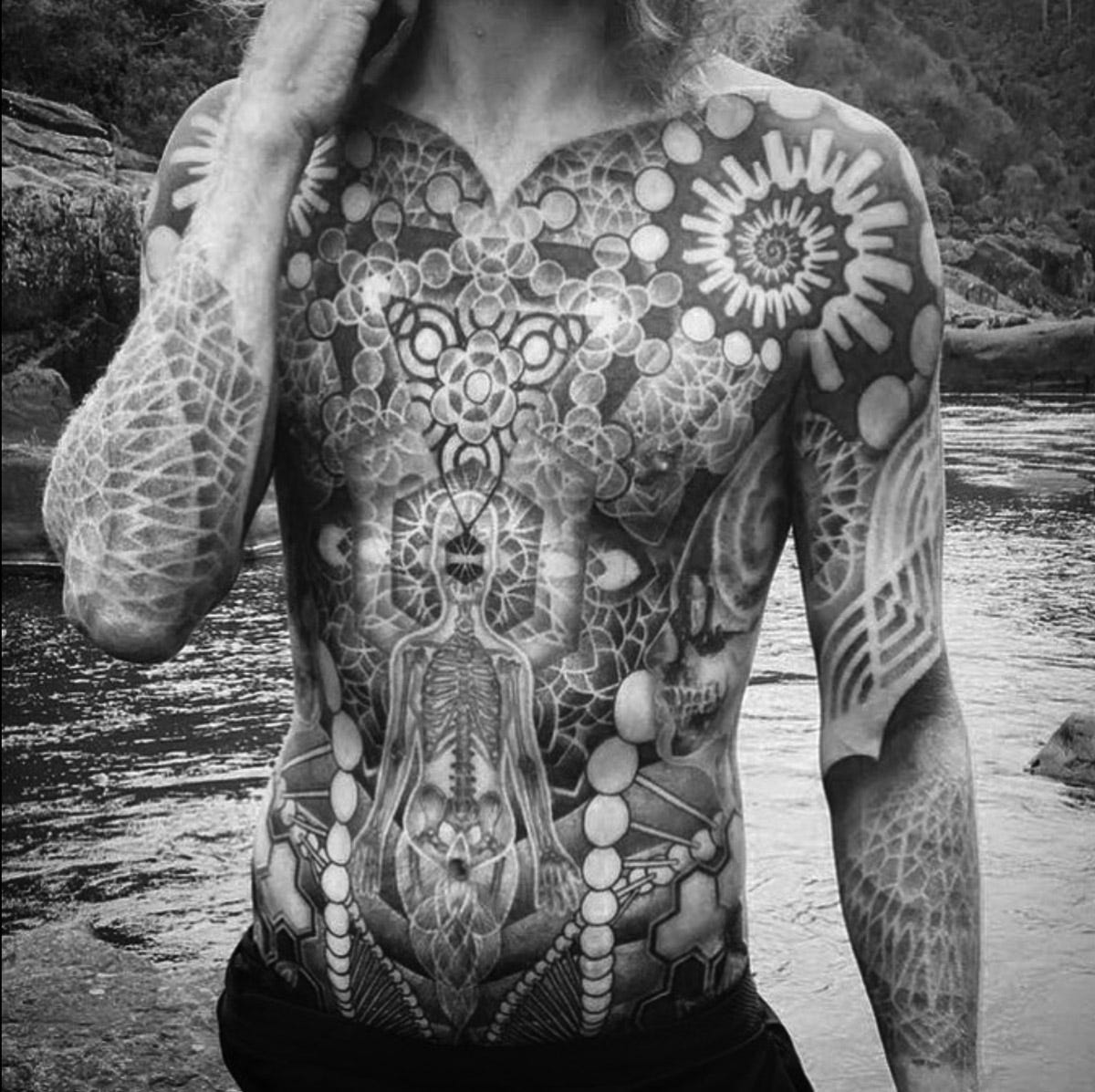
The second layer looks at placement. Where are your tattoos on your body? How do they relate to each other spatially? What overall structure or geometry are they forming? We start to consider how each tattoo sits over different energetic centres, over joints and organs, how they land in relation to movement and flow.
Just as there are energetic points and ley lines across any landscape, the body itself becomes a terrain. And the tattoos reveal tracks and patterns across it.
The psychological map
The third layer is where everything starts to converge. Here we trace the story. We follow the connections between tattoos and the versions of who you were when you received them. We see how the physical marks relate to intention, to relationship, to the sacred: all the principles we’ve covered in the earlier posts in this series.
With all three layers together, the map gives you a genuinely zoomed-out view. You get to ask: what have I built? What does this say about who I’ve been? Are there parts of this story that need to be revisited?
How deep it goes
Depending on the number of tattoos you have, this process can be light and relatively simple, or it can become something quite monumental.
If you have fewer than five tattoos and know that number off the top of your head, it might feel like flipping through a few pages in a journal. But if your body is already significantly traversed, if someone asks how many you have and you’re genuinely not sure, the recovery and reflection can go deep. That’s not a reason to avoid it. If anything it’s a reason to lean in, because buried in those layers, just beneath the surface, is what I call the alluvial gold. The value. The return on investment. The naturally revealed insights that are sitting there waiting to be sorted and understood.
The whole point of mapping is to surface patterns. Unconscious agreements. Programs running in the background. It shows you the deeper logic behind choices you thought were random, or choices you thought you already understood but hadn’t fully examined.
How I work with it
In my own process with people I work with mapping every single time, though what that looks like varies. Sometimes it’s subtle, held in the background of a conversation about the current tattoo. Other times we sit down properly, lay it all out, use a journal, and decode it together. It depends entirely on where someone is.
Early on I realised that tattooing is a record-keeping technology. Without fully knowing it at first, I had been fulfilling the role of scribe with the people I was working with. All tattooists are, in a way. Every time someone came in, there was already something there to be read. If you line up the hieroglyphs, a story starts to emerge. A visual autobiography of who someone is becoming. Like songlines, like ruins, like scripture: the tattoos are holding the information of a particular time and place.
That’s why I created the mapping tool. To give myself and the people I work with a proper ledger. A way to track and read where they’ve been.
We now have templates, a framework, a practice built from years of research in my own studio and through my own personal tattoo journey, which has included exposure to traditional tattoo systems, anatomical symbolism, and older cosmological relationships. We’ve had the mapping exercise printed as a journal for people to work through in their own time. We’ve run group mapping sessions inside the Tattoo Pathway community. And increasingly, I work with people who want to map and orient before we even break skin. Before any physical tattoo happens at all.
This isn’t a psychic reading. It’s a careful, respectful excavation. More like an archaeological dig than anything else. You don’t want to go in with dynamite. You want patience, attention, and a willingness to slow down. But the rewards of that kind of care are real. You start working away on the site and you come across something you didn’t expect. A thread you can follow. A relic with genuine significance.
What’s already there
Here’s what strikes me most about this work. So many people who are deeply invested in their own healing journey pour enormous time and resource into energy work, breathwork, meditation, somatic practices, coaching, medicine journeys. Searching and seeking for clues, wanting to understand who they are and what’s true. And all the while there’s a tattoo, or a scar, or a marking sitting right there on their skin. A rich and valuable landmark, sitting silently, waiting to be read.
There’s something profoundly grounding about the mapping process for exactly that reason. You have to sharpen your awareness, bring yourself into the present, and reach back into the past to that imprint. Noticing where the terrain changes. Noticing if you’ve left something behind. Looking for the evidence of an interaction, a trace of something that mattered.
If you’re going to keep building on that landscape, if you want to keep working with it and constructing something meaningful over time, shouldn’t you pay attention to what’s already there? What was laid before? Identify what in the current structure needs support. Know which aspects are strong and stable. Mapping lets you see the architecture of your story. And from that vantage point, you can build something that will last.
Reflection for Principle Four: Have you mapped your tattoos? Do you know the full evidence of the case? Can you remember where you’ve been?
There’s a map available to you. It’s there. It’s waiting to be read. And what you find in it might just change your whole trajectory.
Previous in the series:
Next in the series:
Mark Nara is a tattoo artist, educator, and founder of Tattoo Pathway, an initiative reframing tattooing as a conscious, transformational practice.